Rails Upgrades

Ruby on Rails Upgrades

Move an application stuck on Rails 3.2, 4.2 or 5.2 to a supported release, one version at a time, without pausing feature work or the business that depends on it.

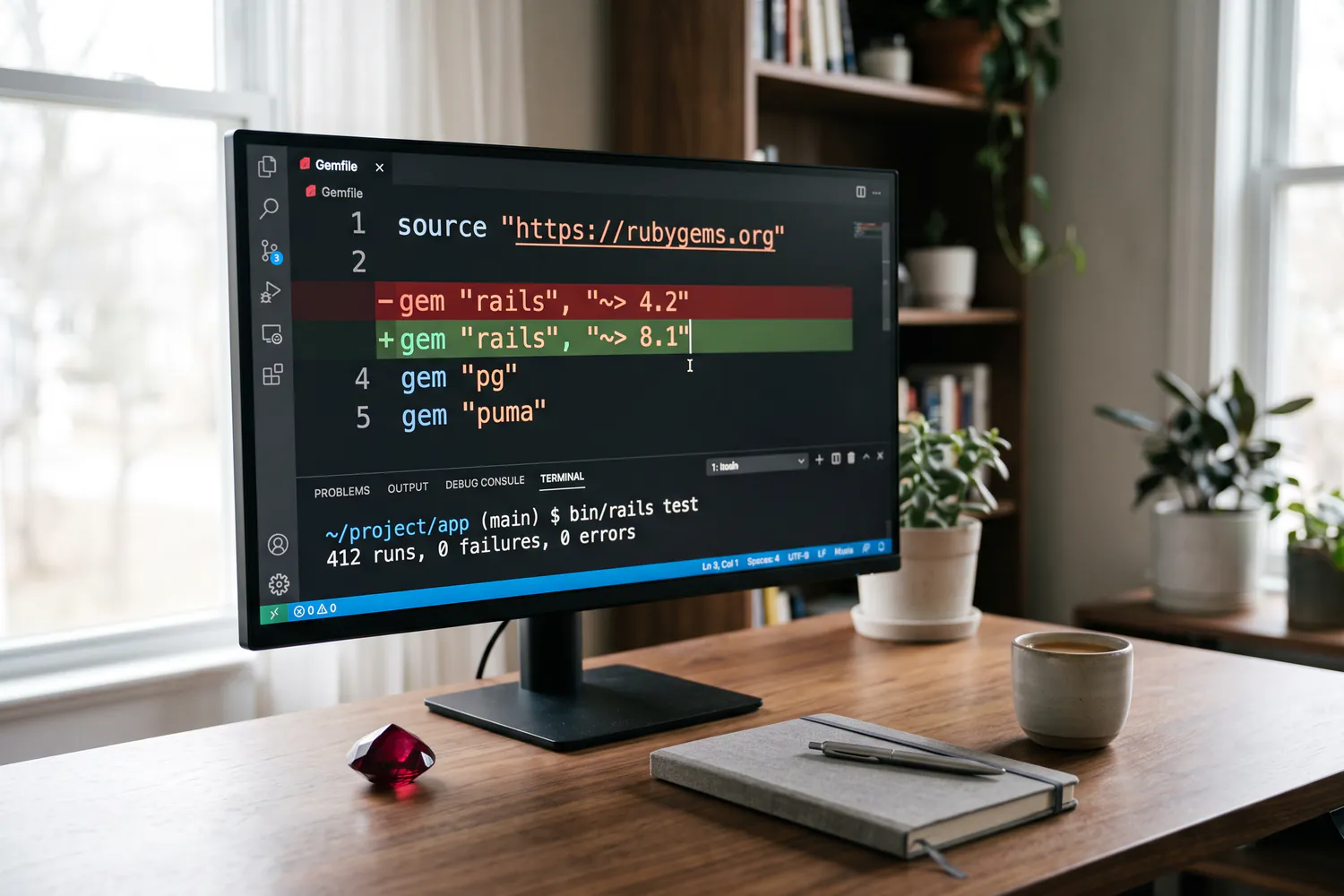
A monitor on a walnut desk showing a Gemfile diff that moves Rails from 4.2 to 8.1 above a passing test run, beside a crimson gemstone
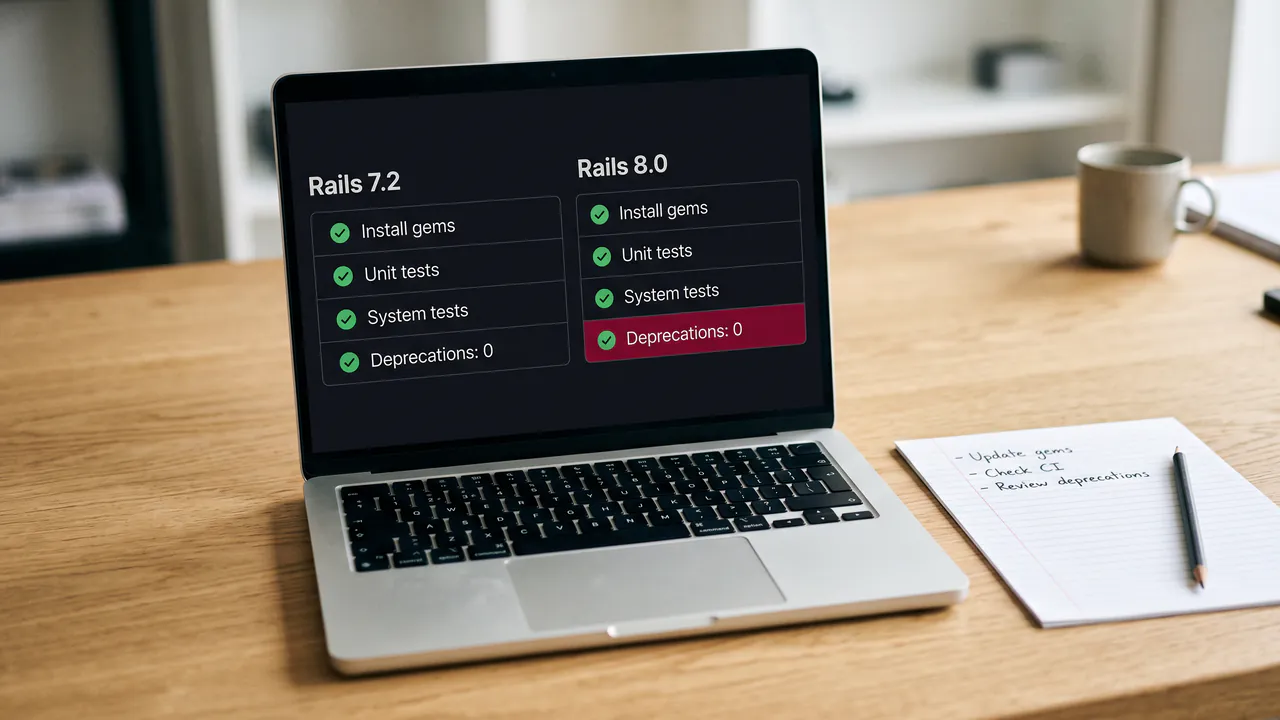
A laptop showing the same build passing on Rails 7.2 and Rails 8.0 side by side, with zero deprecation warnings
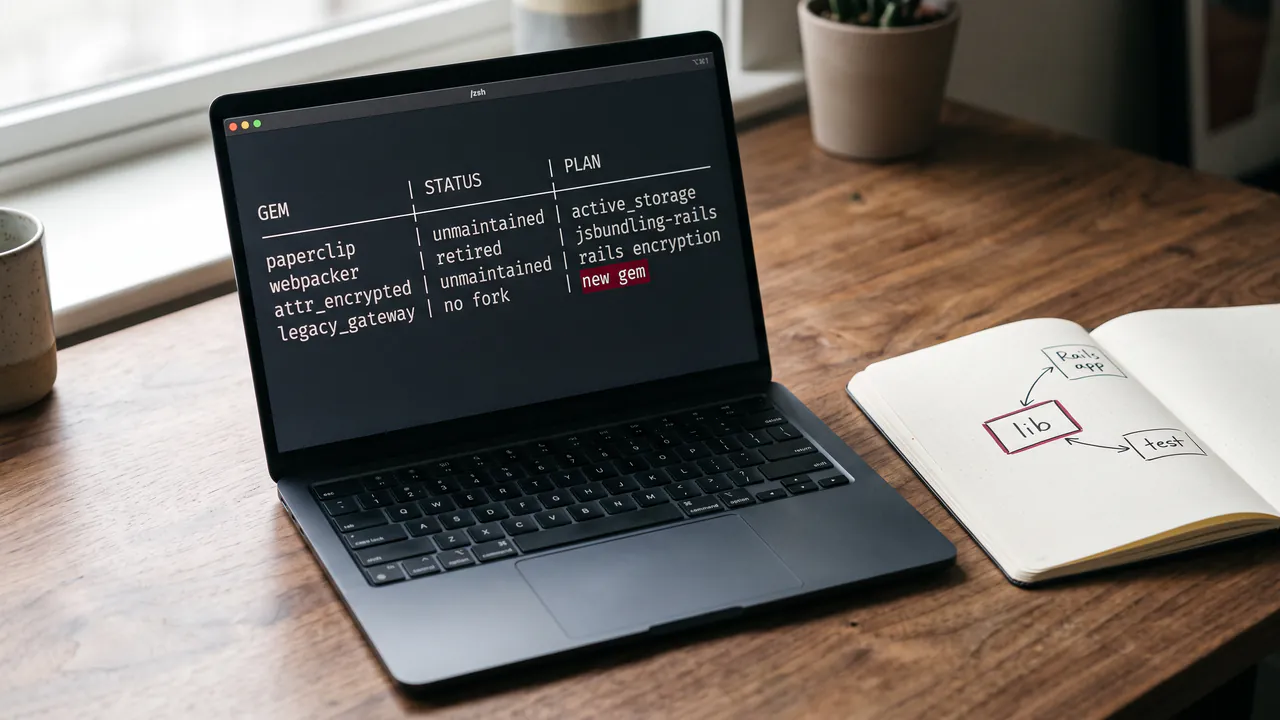
A laptop showing a table of unmaintained gems and their replacements, beside a notebook sketch of a new gem
In payment gateways
10 years
Gifts a year at GivingFire
$100M+
Gateways built
2
Shipped at Edge
3DS + 3RI

An Unsupported Rails Version Is a Liability

Every Rails release gets bug fixes for a year and security fixes for two. After that the Rails team publishes no new versions for it, not even for vulnerabilities, while the vulnerabilities themselves are public knowledge.

I upgrade Rails applications the way I would change a payment gateway in production: in small, reversible steps, with tests around the paths that make money, and with the business running the whole time.

Rails Upgrades Ruby Upgrades Dual Booting Gem Replacement
upgrade

Version-by-Version Upgrades

From Rails 3.2, 4.2 or 5.2 to the current release, one minor version at a time, each step deployed and verified before the next.

code

Ruby and Infrastructure

Ruby upgraded alongside Rails, plus the servers, containers and CI images that an old Ruby kept pinned in the past.

extension

Gem Replacement and New Libraries

Abandoned gems swapped for maintained ones, and new libraries written where no replacement exists.

verified

Tests Before Changes

Request and system tests around sign-up, checkout, billing and integrations before anything is upgraded.

Why Upgrade

Why Rails Upgrades Can't Wait

shield

Security Fixes Stop

Once a release series reaches end of life, a newly disclosed vulnerability in Rails stays open in your application. Attackers read the same advisories you do.

gavel

Compliance and Audits

PCI DSS requires security patches on every system component, and SOC 2 audits and customer security questionnaires ask about them. An unsupported framework is a finding.

dns

Ruby and the Server Underneath

Old Rails pins old Ruby, which is past its own end of life and struggles to build on current operating systems and OpenSSL, so servers stay on unpatched images.

link_off

Gems Move On

Gem authors drop support for old Rails versions. When a gem you depend on ships a security fix, you may not be able to install it.

bolt

Performance and New Features

Current Rails and Ruby bring YJIT, Hotwire, built-in encryption, Solid Queue and simpler deployment. An old version keeps all of that out of reach.

history

Waiting Makes It Bigger

Each skipped release adds to the jump, and developers who know old Rails get harder to hire. Upgrading regularly is far cheaper than catching up.

Support Timeline

Rails Versions and the End of Their Support

Security fixes for each Rails release series ended, or end, on these dates. After them, the Rails team publishes no new versions of that series.

Version Security fixes until Status
Rails 8.1 10 Oct 2027 check Supported
Rails 8.0 7 Nov 2026 check Supported
Rails 7.2 9 Aug 2026 warning End of life
Rails 7.1 1 Oct 2025 warning End of life
Rails 7.0 1 Apr 2025 warning End of life
Rails 6.1 1 Oct 2024 warning End of life
Rails 6.0 1 Jun 2023 warning End of life
Rails 5.2 1 Jun 2022 warning End of life
Rails 5.1 25 Aug 2019 warning End of life
Rails 5.0 9 Apr 2018 warning End of life
Rails 4.2 27 Apr 2017 warning End of life
Rails 4.1 12 Jul 2016* warning End of life
Rails 4.0 6 Jan 2015* warning End of life
Rails 3.2 14 Sep 2016* warning End of life

* Rails had no fixed end dates before 4.2, so these rows show the date of the series' final release.

Sources: Rails maintenance policy · endoflife.date · RubyGems release history

The Upgrade Approach

Small Steps, Always Deployable

  1. 01

    Audit

    I review the Rails and Ruby versions, every gem against the target release, the test suite and the infrastructure, then give you a written plan with the order of work and an estimate.

  2. 02

    Tests first

    Before anything changes, I add request and system tests around the paths that make money: sign-up, checkout, billing, reports and integrations.

  3. 03

    Dual boot

    The app runs against both the current and the next Rails version in CI, so upgrade work lands on main in small pull requests instead of a long-lived branch.

  4. 04

    One version at a time

    4.2 to 5.0, 5.0 to 5.1, and so on: deprecation warnings fixed first, then each release's new framework defaults switched on one by one.

  5. 05

    Ruby and dependencies

    Ruby moves up where Rails requires it, abandoned gems are replaced, and missing libraries are built, so no single dependency blocks the next step.

  6. 06

    Release and monitor

    Each step ships to production on its own, with error tracking and performance monitoring watched closely and a rollback ready.

Libraries

When a Gem Doesn't Make the Jump

Upgrades usually stall on dependencies, not on Rails itself: a gem abandoned years ago, pinned to an old Rails, with no newer release. I find the maintained replacement and migrate your code and data to it.

Paperclip

arrow_forward Active Storage or Shrine

Deprecated by its maintainers in 2018.

Webpacker

arrow_forward jsbundling-rails, importmap-rails or Vite Ruby

Retired after Rails 7 changed how JavaScript is bundled.

attr_encrypted

arrow_forward Active Record Encryption

Encrypted attributes are built into Rails since 7.0.

protected_attributes

arrow_forward Strong Parameters

Strong Parameters replaced attr_accessible in Rails 4.

Turbolinks

arrow_forward Turbo

Turbolinks is no longer maintained; Turbo succeeded it.

Sprockets

arrow_forward Propshaft

Propshaft is the default asset pipeline from Rails 8.

construction

Building What Doesn't Exist

Sometimes there is no replacement: a payment processor, a partner API or an industry format whose only Ruby client stopped at Rails 4. Then I write the library myself, so the upgrade isn't held hostage by someone else's abandoned code.

  • check_circle Forks patched for the new Rails and Ruby versions, with the fixes offered upstream.
  • check_circle New gems with their own tests, CI and versioning, kept in your repository or published.
  • check_circle Adapters that put a new library behind the old interface, so the rest of the app doesn't change.
Track Record

10 Years Inside Payment Gateways

Since 2017 my work has been payment infrastructure: first as the sole engineer on GivingFire's gateway, then building and leading engineering at Edge Payments Technologies. Systems that move money leave no room for shortcuts, and I bring that standard to every project.

payments

Edge Payments Technologies

Lead Software Engineer and Head of Compliance · 2022 – present

  • check_circle Built the company's Ruby on Rails payment gateway.
  • check_circle Integrated the RS2, NMI and Moov processors for card and ACH payments.
  • check_circle As head of compliance, turned sponsor bank and card network requirements into controls built into the platform.
volunteer_activism

GivingFire

Senior Software Engineer · 2017 – 2022

  • check_circle Sole engineer for five years on a Rails payment gateway and donation platform.
  • check_circle Scaled it to process $100M+ in gifts a year across card, ACH and cash.
  • check_circle Built integrations with Salesforce, Planning Center, Breeze and Zapier.
See the full work history arrow_forward
Transparent Pricing

Scope-Based Engagement

  • check_circle Discovery & Requirements Session
  • check_circle Technical Architecture Document
  • check_circle Source Code & Documentation Handover

Project Pricing

Custom Quote

Scope-based pricing tailored to your project complexity and timeline.

Hourly Rates

Short-term contracts

$50/hr

Advisory, code review, fixes, and short projects.

Long-term, full-time

$30/hr

Ongoing full-time contracts, working as part of your team.

Common Questions

How long does a Rails upgrade take? expand_more

It depends on how far behind the app is, how well it is tested and how many gems it uses. One minor version on a well-tested app can take days; Rails 4 to the current release on a large app is months of work alongside features. The audit gives you an estimate before you commit.

Can we keep shipping features during the upgrade? expand_more

Yes. With dual booting, upgrade changes land on main in small pull requests that work on both Rails versions, so there is no long-lived branch to merge at the end.

Should we rewrite the application instead? expand_more

Rarely. A rewrite throws away years of fixed edge cases and stops the business from changing while it happens. An upgrade keeps everything that works and delivers value at every step.

Our app has few tests. Can it still be upgraded? expand_more

Yes. Tests come first: I cover the critical paths before changing anything, and that coverage stays with you after the upgrade.

Stuck on an Old Rails Version?

Tell me which Rails and Ruby versions you run, roughly how big the app is and what depends on it, and I'll get back to you with next steps.

View Work History