My Approach to AI
I have always loved programming, and I love getting things done. AI lets me do more of both, with the discipline that 14 years in the field have taught me.
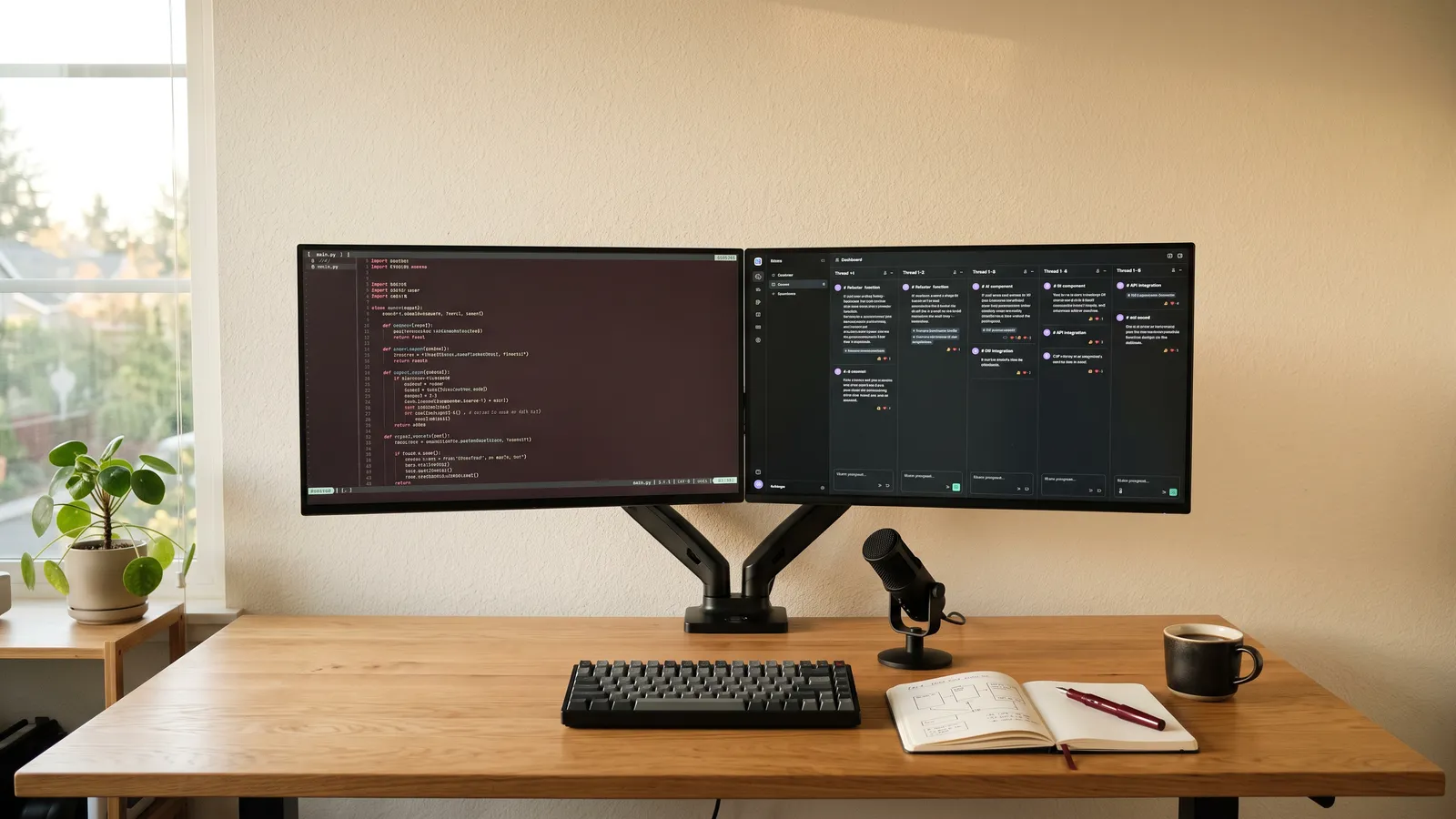
I still love to code
Programming has always been my way of communicating with the machine. For me it is close to eye contact, touch and speech: the way you connect with a living being. AI has not changed that.
And I get things done
As an independent contractor, I have often joined teams with difficult codebases and had to deliver quickly, with little or no time to improve things first. Businesses rightly want a disciplined approach, and that is where 14 years of experience count: I decide the architecture, review what lands, and own the result.
Two ways of working
Depending on the task, I either go fully old school or quite literally hands free.
Hands on
When a task needs my full attention, I write the code myself. Cursor, for its Tab completion, is my everyday editor. When I want no AI at all, I go old school: Neovim with nothing but the LSP.
Hands free
When the work can be delegated, I prompt by voice in T3 Code, with many threads running in parallel across several projects. Claude Code and Codex run inside T3, unless they are starting a new project or I am tinkering with the system.
The right model for the task
I used to say "use the right tool for the right task". The same applies to the model. My preferred ecosystems are Claude, ChatGPT and Codex, xAI, and T3 Code, and each model has a role on the team.
-
architectureAnthropic
Claude Fable
Architecture
Fable and I plan the architecture together.
-
design_servicesAnthropic
Claude Opus
Feature planning and implementation
Opus and I plan features and build them. I am the lead; Opus is the all-round senior engineer. Anthropic models take the human-facing work: design and most of the code.
-
verifiedOpenAI
Sol 6.1
Code and plan review
A second opinion before and after the code is written. Sol is good at finding the edge cases.
-
query_statsOpenAI
ChatGPT
Research
The research I do hands-on, working through a question with the AI.
-
groupsxAI
Grok
A colleague
The Grok bot runs on its own, in loops: it looks for leads, does research, and more.
-
dashboardT3
T3 Code
Orchestration
Where the work comes together: T3 Code handles several projects at once, usually running in parallel, with Claude Code and Codex inside it.
Professional, and flexible
This is how I work by choice. When a team has its own tools, its own rules, or no AI at all, I adapt and work within them.