From LankaDreamHomes to Estate: Why I Rebuilt My Real-Estate Software in Phoenix
Real estate has been part of my life for longer than software engineering has. I've worked as an agent in a limited capacity since my university days, and the software I'm now calling Estate has followed me through almost all of it. This is the story of how it got here, and why its latest version is written in Elixir and Phoenix rather than Ruby on Rails.
2008 to 2012: LankaDreamHomes on WordPress
Between 2008 and 2012 I ran a one-man agency, and I built LankaDreamHomes on WordPress to support it. It wasn't a product. It was the tool I needed to list properties and be found online, and WordPress was the quickest way to get there.
In 2012 I moved to Colombo and stopped working as a realtor so I could focus on my career as a software engineer. The real-estate work didn't disappear completely, though. I helped a few realtors set up their own online presence with WordPress, built from what I'd learned running my own.
2013: The move to Ruby on Rails
In late 2013 I migrated the platform to Ruby on Rails. By then I was freelancing on oDesk (now UpWork), and the Rails version became the base I used for real-estate projects there.
One thing was always missing: 360° panoramas and virtual tours. I had a theory of how to build them, but no way to really test it. Doing it properly needs a DSLR, a fish-eye lens and stitching software, and back then I couldn't afford any of those. So the idea sat on the shelf for years.
How Edge Payment Technologies led me to Phoenix
What changed my mind about the stack was joining Edge Payment Technologies, a US payment gateway, where I was the lead engineer of the Tooling division. Edge ran on Phoenix: the main application, invoices, paylinks and the hosted-checkout solutions were all built with it.
Working on payment software every day showed me what Elixir and the BEAM are like in production, where uptime and correctness matter. Once I'd seen that, going back to Rails for my own project was hard to justify.
2023: A fresh start with Elixir and Phoenix
In 2023 I decided to start again, and I built Estate with Elixir and Phoenix. It wasn't a port of the Rails app. It was a rewrite with a clear set of goals:
- Performance and a low memory footprint. The BEAM runs lightweight processes cheaply, so the app does more on smaller servers.
- Resilience. Supervision trees mean that when a part of the system fails, it's restarted on its own instead of taking everything down with it.
- Clustering and the rest of the BEAM. Elixir gets distribution, clustering and decades of telecom-grade engineering from Erlang without bolting on extra infrastructure.
- LiveView instead of React. LiveView's server-rendered reactivity covers what I'd otherwise reach for React to do. That removes a whole second application, a build pipeline and an API layer, which makes Estate easier to develop and maintain.
All of it comes back to one aim: a resilient application that is easy and economical to run. That mattered because I was planning to go back into real-estate brokering myself.
Why go back to brokering?
I work as a remote independent contractor, and that means I meet far fewer people than I'd like. Brokering gets me out of the house. I meet buyers, sellers and owners, and it gives me a reason to take out my DSLR and photograph properties again. Estate had to be something I could run for my own agency without it turning into a second job.
A big push from Claude Opus 4.5
The work picked up pace considerably when Anthropic introduced Claude Opus 4.5. Building and maintaining software like this on my own is a lot of surface area for one person, and having a capable model to work through features with made it far more achievable alongside contract work.
Finally: 360° virtual tours
Today Estate has 360° virtual tours, the feature I wanted for so many years and could never test back in the Rails days. It's satisfying to see it running in software I'll actually use with my own clients.
What Estate is now
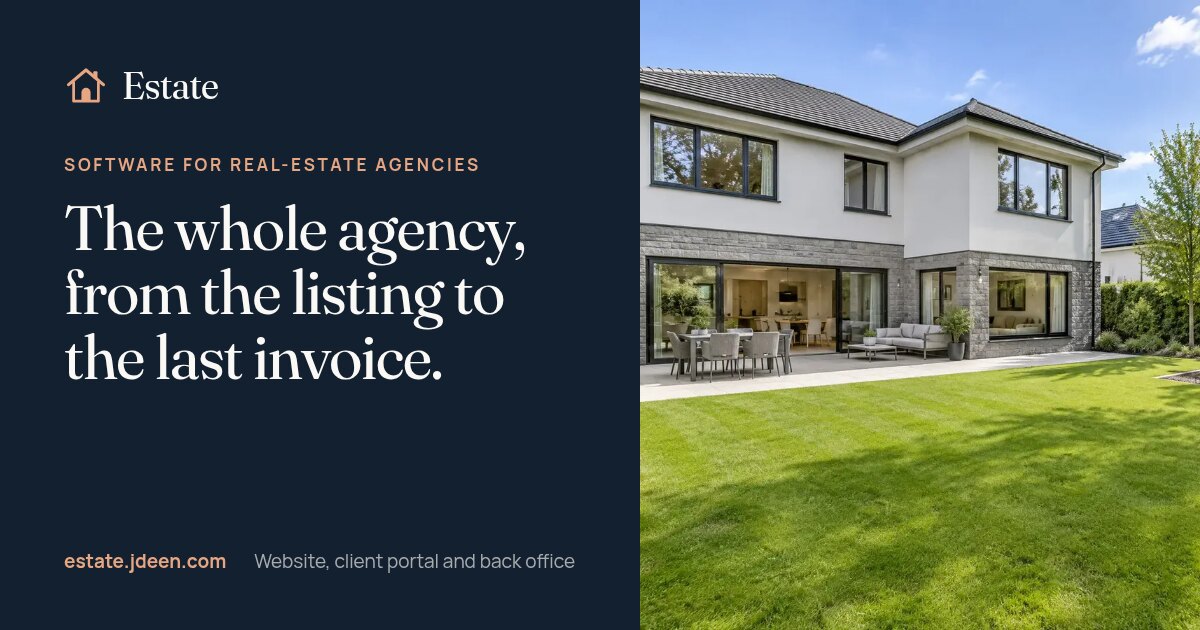
Estate covers the whole agency, from the listing to the last invoice: a public website, a client portal and a back office. You can see what it does at estate.jdeen.com.
It took eighteen years, three platforms and a lot of patience to get from LankaDreamHomes to here, and I'm glad I kept coming back to it.